
Biology 2e · The Study of Life
The Science of Biology
On this page 9 sections
In 30 seconds
biology The scientific study of life and living systems. is the scientific study of life: how living things are built, how they obtain and use energy, how they reproduce, how populations change over generations, and how organisms interact with one another and their surroundings. Its scale is unusually broad. A biologist might investigate a molecule inside one cell, the development of an embryo, a disease spreading through a population, or nutrient cycling across a forest.
The subject is not simply a catalog of organisms. Biology asks testable questions about living systems and uses evidence to improve explanations. Because living things are complex and variable, biologists often combine careful observation, measurement, comparison, controlled experiments, models, and data analysis. The aim is not to prove an idea forever; it is to build explanations that account for the available evidence and can be checked by others.
Why this matters
Biological reasoning helps people evaluate claims about health, food, biodiversity, heredity, and environmental change. For example, deciding whether a treatment is useful requires more than a dramatic personal story: it requires relevant evidence, comparison, and an awareness of alternative explanations. These habits carry through every later unit, from cell chemistry to evolution and ecology.
The college version
Core Concepts
What makes something living?
No short checklist captures every borderline case, but living organisms share several important features. They are organized, typically as one or more cells; use energy and matter to maintain themselves; respond to internal or external conditions; grow and develop; reproduce; and, as populations, evolve over time. Organisms also regulate internal conditions, such as water balance or temperature, within limits. Viruses illustrate why definitions need care: they contain genetic material and evolve, but they cannot carry out metabolism or reproduce independently of a host cell.
Biology is organized across levels
Living systems can be examined at nested levels: atoms and molecules form organelles; organelles operate within cells; cells make tissues; tissues form organs; organs cooperate in organ systems; and organ systems make an organism An individual living thing. Full entry →. Above an individual are populations of the same species, communities of interacting populations, ecosystems that include nonliving factors, and the biosphere. A change at one level can affect another. For instance, a mutation in DNA may alter a protein, which changes a cell’s behavior and can influence an organism’s traits.
Scientific questions and evidence
Science begins with observations and questions that can be investigated. A hypothesis A tentative, testable explanation for an observation or question. Full entry → is a proposed, testable explanation, not a random guess. From it, scientists derive a prediction An expected result that follows from a hypothesis under stated conditions. Full entry →: if the explanation is useful, then a particular result should be more likely under stated conditions. Researchers then collect data through observations, experiments, field studies, or analyses of existing records.
In a controlled experiment, investigators change one independent variable The factor an investigator deliberately changes or compares. Full entry → and measure a possible effect, the dependent variable The outcome measured in response to the independent variable. Full entry →, while trying to keep other relevant conditions similar. A comparison group provides a baseline. Replication and adequate sample size matter because biological systems vary naturally and because a pattern from one trial may be due to chance. Controls do not make an experiment perfect, but they make causal conclusions stronger.
Evidence can support, weaken, or complicate a hypothesis. A result that disagrees with a prediction is valuable: it may reveal an error in the method, show that an assumption was wrong, or point toward a better explanation. Scientific knowledge is therefore reliable because it is open to testing and revision, not because it is unchangeable.
Models, theories, and collaboration
Biologists use models such as diagrams, computer simulations, cell cultures, and laboratory organisms to focus on key features of a system. Every model A simplified representation used to describe, explain, or predict part of a system. Full entry → leaves something out, so a model’s usefulness depends on the question being asked. A simplified food web may clarify energy relationships even though it cannot represent every individual interaction in nature.
A scientific theory A broad explanation strongly supported by many lines of evidence and repeated testing. Full entry → is not a casual opinion. It is a broad, evidence-based explanation that has survived repeated testing and connects many observations. Evolution by natural selection and cell theory are examples. Scientists communicate methods and results so that other researchers can critique, repeat, or extend the work. Peer review helps assess research before publication, but it is one quality check rather than a guarantee that every conclusion is final.
How It Works / Step-by-Step Process
- Make a focused observation, such as noticing that seedlings near a window lean toward the light.
- Turn it into a testable question: does light direction affect the direction of seedling growth?
- Propose a hypothesis and prediction. For example, if seedlings respond to directional light, then plants exposed to light from one side should bend toward that side more often than plants lit evenly from above.
- Design a comparison: use similar seedlings, keep water, soil, temperature, and growth time alike, and vary the light direction. Measure the angle of each stem rather than relying on impressions.
- Analyze repeated results, judge whether they fit the prediction, and report the limits. If the pattern is weak or inconsistent, revise the explanation or test a new one.
Common Confusions
| Common Confusion | Correct Understanding |
|---|---|
| A hypothesis is a guess. | A hypothesis is a proposed explanation that makes testable predictions and is grounded in prior observations or knowledge. |
| A theory becomes a law after enough proof. | Laws describe consistent patterns; theories explain how or why patterns occur. They serve different roles. |
| One experiment establishes truth. | A single study can supply evidence, but replication, critique, and converging evidence make conclusions stronger. |
| The control group is the group with no variables. | It is a comparison group; it still has conditions and may differ only in the treatment being tested. |
| “Living” can be decided by one feature alone. | Biologists weigh multiple properties, especially for edge cases such as viruses. |

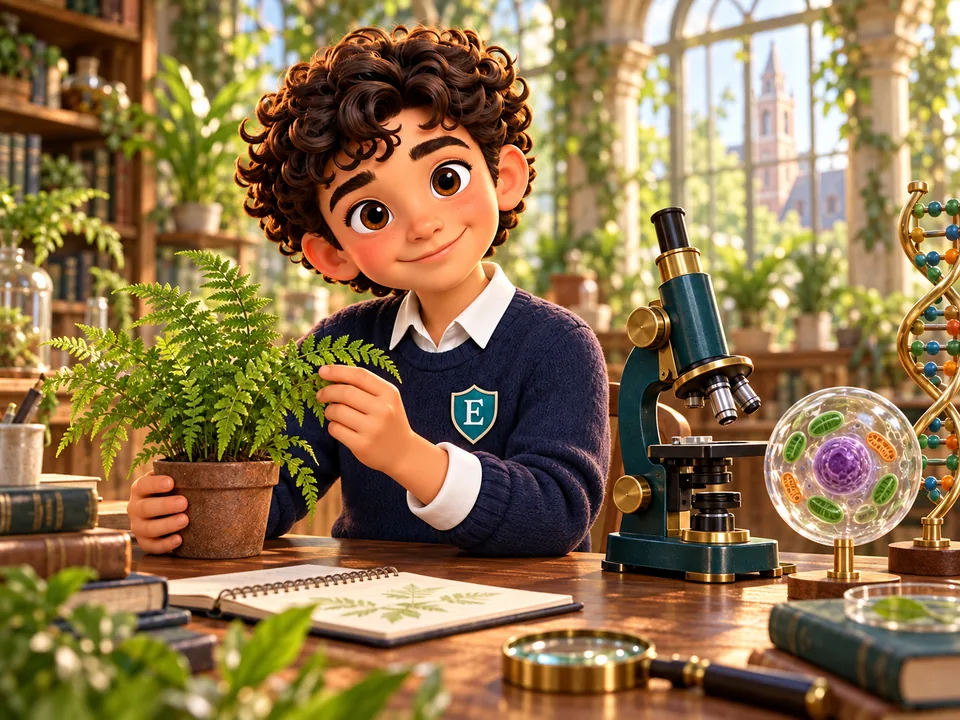
Eli explains
The same idea, in plain words
Explain it like I’m 10
Biology is like being a detective for living things, from tiny cells to whole forests. Biologists notice patterns, ask questions, and test ideas with evidence instead of choosing the answer they like best. When new clues appear, they may improve their explanation.
Worked example
Suppose a class tests whether fertilizer concentration affects duckweed growth. Each group begins with the same number of duckweed fronds in identical containers. One group receives no fertilizer, while other groups receive low, medium, or high concentrations; all containers get the same light, water volume, and temperature. After a week, students count fronds and compare average growth.
Fertilizer concentration is the independent variable, and change in frond number is the dependent variable. The no-fertilizer group is a control. If medium fertilizer produces the most growth while high fertilizer reduces it, the justified conclusion is not “fertilizer always helps plants.” It is that, under these conditions, growth depended on concentration and too much fertilizer may have been harmful. Repeating the investigation and testing other species would show how widely that conclusion applies.
Key takeaways
- Life has shared properties: cellular organization, energy use, regulation, response, growth, reproduction, and evolution are useful lenses, not a mechanical checklist.
- Levels interact: events at molecular, cellular, organismal, population, and ecosystem levels can be connected.
- A hypothesis must be testable: it proposes an explanation that could be supported or challenged by observations.
- Experiments isolate variables when possible: comparisons, controls, replication, and sample size help distinguish an effect from ordinary variation.
- Science is revisable: evidence changes confidence in explanations; it does not provide absolute certainty.
Check yourself

5 review questions from the chapter. Try each one, then open the answer.
Name four characteristics commonly used to describe living organisms.
Show answer
Possible answers include cellular organization, energy use, homeostasis, response to conditions, growth and development, reproduction, and evolution of populations.
Why is a testable prediction useful when evaluating a hypothesis?
Show answer
It states a result that should occur if the hypothesis is useful, so evidence can evaluate the explanation.
In the duckweed investigation, identify the independent variable, dependent variable, and control group A comparison group that does not receive the experimental treatment. Full entry →.
Show answer
Fertilizer concentration is the independent variable; duckweed growth (change in frond number) is the dependent variable; the no-fertilizer containers are the control group.
Why do replication and controlled comparisons strengthen a biological conclusion?
Show answer
They reduce the chance that a result reflects random variation, an unnoticed condition, or an unusual sample rather than the tested factor.
How is a scientific theory different from an everyday use of the word “theory”?
Show answer
In science, a theory is a thoroughly tested, evidence-based explanatory framework; in everyday speech, “theory” may mean an unsupported hunch.
Study toolsKey vocabulary
Key vocabulary
- biology
- The scientific study of life and living systems.
- organism
- An individual living thing.
- homeostasis
- The maintenance of relatively stable internal conditions despite changes inside or outside an organism.
- hypothesis
- A tentative, testable explanation for an observation or question.
- prediction
- An expected result that follows from a hypothesis under stated conditions.
- independent variable
- The factor an investigator deliberately changes or compares.
- dependent variable
- The outcome measured in response to the independent variable.
- control group
- A comparison group that does not receive the experimental treatment.
- scientific theory
- A broad explanation strongly supported by many lines of evidence and repeated testing.
- model
- A simplified representation used to describe, explain, or predict part of a system.
Sources & references
This lesson was adapted from the open educational references above; their licenses and attributions are preserved. See Copyright & Licensing.
Educational content only. It is not medical, legal or professional advice. Found an error? Tell us.