
Chemistry: Atoms First 2e · Atoms, Molecules, and Ions
Early Ideas in Atomic Theory
On this page 9 sections
In 30 seconds
The idea that matter is made of tiny, indivisible particles is more than 2,000 years old. Greek philosophers proposed the concept of the atom The smallest particle of an element that retains its identity in chemical reactions Full entry → (from atomos Greek word meaning "indivisible" Full entry →, meaning "indivisible"), but their arguments were philosophical rather than experimental, and a rival view — that matter is continuous — dominated science for centuries. It was not until the early 1800s that John Dalton converted the ancient guess into a testable scientific theory with a set of specific postulates. Dalton's theory explained three fundamental chemical laws — the conservation of mass, definite proportions, and multiple proportions — and it remains the framework on which all of modern chemistry is built, even though two of its postulates were later modified.
Why this matters
Every chemical equation you will ever balance depends on the principle that atoms are neither created nor destroyed, and every formula for a compound depends on the idea that elements combine in fixed, whole-number ratios. Understanding where these ideas came from shows why they are laws rather than conventions: they summarize thousands of reproducible measurements. This topic also matters for exams, which frequently ask you to match Dalton's postulates Four statements describing atoms, compounds, and chemical reactions Full entry → with the experimental laws they explain, and to identify which parts of the early theory were later corrected.
The college version
Core Concepts
Ancient Greek atomism
Around 440 BCE, the Greek philosophers Leucippus and Democritus proposed that matter consists of tiny, hard, indivisible particles called atoms moving through empty space. They reasoned that different substances differ because their atoms differ in shape, size, or arrangement. This was a bold and remarkably modern idea, but it was based on logic and debate, not measurement — there was no experiment that could confirm or refute it.
Aristotle's continuous matter
Aristotle (about 350 BCE) rejected the idea of empty space, arguing that matter is continuous and made of combinations of four elements: earth, water, air, and fire. Because Aristotle's authority was immense, his view of continuous matter was accepted for roughly 2,000 years. During that time, alchemists practiced a blend of craft and speculation, developing useful techniques such as distillation and useful equipment such as crucibles and flasks, but they did not advance a scientific atomic theory.
Dalton's atomic theory
In the early 1800s, John Dalton proposed a theory with four postulates:
- Each element is composed of extremely small particles called atoms.
- Atoms of a given element are identical in size, mass, and other properties; atoms of different elements differ.
- Compounds are formed when atoms of different elements combine in simple, whole-number ratios.
- In a chemical reaction, atoms are rearranged to form new substances; atoms are neither created nor destroyed.
The power of these postulates was that they could be tested against measurements of how elements actually combine.
The three laws Dalton's theory explained
Dalton's theory gave a satisfying explanation for three empirical laws:
- law of conservation of mass Mass is neither created nor destroyed in a chemical reaction Full entry →: In a chemical reaction, the total mass of the reactants equals the total mass of the products. This follows from postulate 4: since atoms are only rearranged, no mass is gained or lost.
- law of definite proportions A compound always has the same elemental mass ratio Full entry →: A given compound always contains the same elements in the same proportion by mass. This follows from postulates 2 and 3: if atoms of an element are identical and compounds form in fixed ratios, the mass ratio must be fixed.
- law of multiple proportions Combining-mass ratios across related compounds are small whole numbers Full entry →: When two elements form more than one compound, the masses of one element that combine with a fixed mass of the other are in a simple, whole-number ratio. For example, carbon and oxygen form both CO and CO₂.
Limits of the early theory
Two postulates were later shown to be incomplete. Postulate 1 (atoms indivisible) fails because atoms contain subatomic particles and can be split in nuclear reactions. Postulate 2 (all atoms of an element identical) fails because isotopes of the same element have different masses. Dalton also sometimes guessed the simplest possible formulas, such as HO for water, when experiment later showed H₂O. These corrections did not destroy the theory; they refined it, which is how science normally progresses.
How It Works / Step-by-Step Process
- Identify which law or postulate a question describes by its key words: "always same ratio" (definite proportions), "two compounds, two ratios" (multiple proportions), "reactants = products" (conservation of mass).
- For multiple-proportions problems, fix the mass of one element and compare the masses of the other element.
- State the whole-number ratio, then connect it back to Dalton's picture of atoms joining in fixed ratios.
Common Confusions
| Do Not Confuse | With | Difference |
|---|---|---|
| Dalton's postulates | Modern atomic theory | Postulates 1 and 2 were refined: atoms are divisible and isotopes of an element differ in mass. |
| Law of definite proportions | Law of multiple proportions | Definite: one compound, fixed ratio. Multiple: two elements forming several compounds, ratios of ratios are whole numbers. |
| Greek atomism | Dalton's theory | Greeks argued from philosophy with no measurements; Dalton's theory was built on quantitative experimental laws. |
| Alchemy | Chemistry | Alchemy contributed techniques and equipment but not a systematic, testable atomic theory. |
| Mass conservation | Mass "disappearing" in reactions | Mass is conserved in chemical reactions; apparent loss (like gas escaping) is a measurement or containment problem, not a violation. |

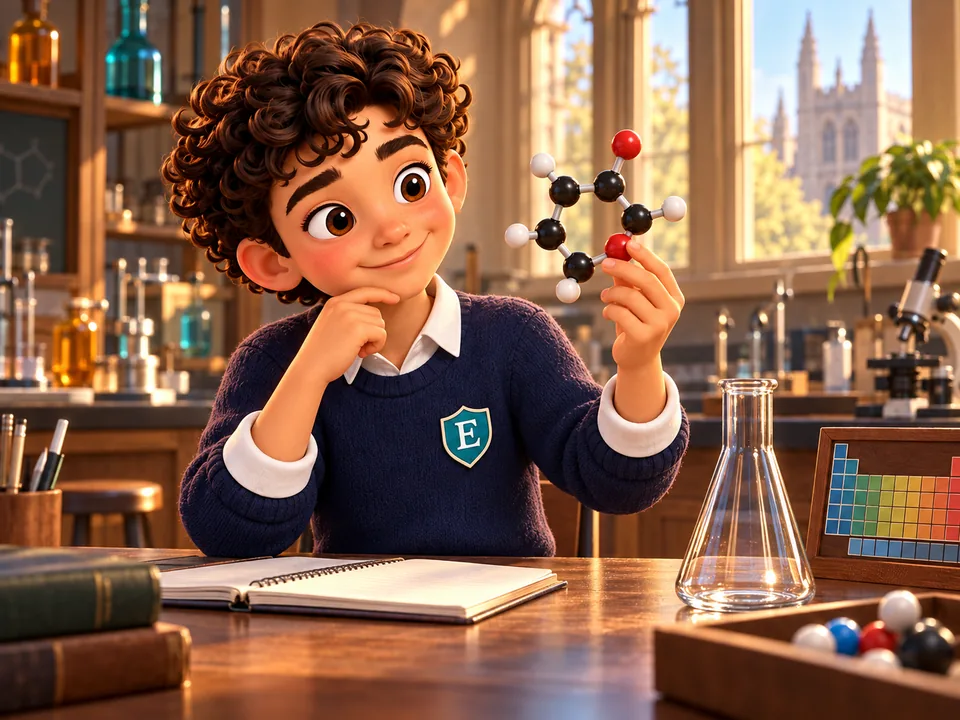
Eli explains
The same idea, in plain words
Explain it like I’m 10
Long ago, Greek thinkers guessed that everything is made of tiny unbreakable pieces called atoms, but they could not prove it. A scientist named John Dalton later used weighing experiments to show that matter really does behave as if it is made of atoms that join in simple ratios. His rules explain why baking a cake does not change the total weight: the same ingredients are just rearranged.
Worked example
Worked Example 1: Law of multiple proportions with carbon oxides
Carbon and oxygen form carbon monoxide (CO) and carbon dioxide (CO₂). For a fixed mass of 12.01 g of carbon, CO contains 16.00 g of oxygen while CO₂ contains 32.00 g of oxygen. Show that this obeys the law of multiple proportions.
Hold the carbon fixed and form the ratio of oxygen masses:
mO in CO2mO in CO = 32.00 g16.00 g = 21
The ratio 2:1 is a simple whole-number ratio, exactly as Dalton's theory predicts: the two compounds correspond to one oxygen atom per carbon (CO) versus two oxygen atoms per carbon (CO₂). If atoms were not discrete, no such clean ratio would appear.
Worked Example 2: Law of definite proportions applied to water
Pure water always contains hydrogen and oxygen in the mass ratio 2.016 : 15.999, because a water molecule is H₂O. Using atomic masses, the percent of hydrogen by mass is
2 × 1.008 u2 × 1.008 u + 15.999 u × 100% = 2.01618.015 × 100% = 11.19%
So every sample of pure water — a raindrop or a lake — is 11.19% hydrogen by mass. If a water sample contains 8.00 g of hydrogen, the mass of oxygen combined with it is
mO = 8.00 g H × 15.999 g O2.016 g H = 63.5 g O
The ratio check: 63.5 g to 8.00 g is the same 15.999 to 2.016 ratio, confirming that the proportion is fixed regardless of sample size.
Key takeaways
- The word atom comes from Greek atomos, "indivisible"; Greek atomism was philosophical, not experimental.
- Aristotle's four-element, continuous-matter view dominated for about 2,000 years.
- Dalton's four postulates: atoms exist; atoms of an element are identical; compounds form in whole-number ratios; atoms are conserved in reactions.
- Law of conservation of mass: total reactant mass equals total product mass.
- Law of definite proportions: a compound's elemental mass ratio is fixed.
- Law of multiple proportions: ratios of combining masses across related compounds are simple whole numbers.
- Modern corrections: atoms are divisible (subatomic particles, nuclear reactions) and isotopes of an element differ in mass.
Check yourself

5 review questions from the chapter. Try each one, then open the answer.
What does the Greek word atomos mean, and why is the Greek idea of the atom called philosophical rather than scientific?
Show answer
Atomos means "indivisible." The Greek proposal was based on reasoning about the nature of matter, with no experiments or measurements to test it, so it was a philosophical idea rather than a scientific theory.
State the four postulates of Dalton's atomic theory.
Show answer
(1) Elements are made of tiny particles called atoms; (2) atoms of a given element are identical and atoms of different elements differ; (3) compounds form when atoms combine in simple whole-number ratios; (4) atoms are rearranged, not created or destroyed, in chemical reactions.
Which law says a given compound always contains the same elements in the same proportion by mass?
Show answer
The law of definite proportions.
Carbon and oxygen form CO and CO₂. Why does the 2:1 oxygen mass ratio support the existence of atoms?
Show answer
If matter were continuous, there would be no reason for the combining masses to fall into a clean 2:1 ratio. The ratio is exactly what you expect if atoms of oxygen attach one at a time (one O per C versus two O per C).
Which two postulates of Dalton's theory were later modified, and by what discoveries?
Show answer
Postulate 1 (indivisible atoms) was modified by the discoveries of subatomic particles and nuclear reactions; postulate 2 (identical atoms of an element) was modified by the discovery of isotopes.
Study tools & related lessonsKey vocabulary · Related
Key vocabulary
- atom
- The smallest particle of an element that retains its identity in chemical reactions
- atomos
- Greek word meaning "indivisible"
- alchemy
- Ancient practice combining craft and speculation about transforming matter
- Dalton's postulates
- Four statements describing atoms, compounds, and chemical reactions
- law of conservation of mass
- Mass is neither created nor destroyed in a chemical reaction
- law of definite proportions
- A compound always has the same elemental mass ratio
- law of multiple proportions
- Combining-mass ratios across related compounds are small whole numbers
Sources & references
This lesson was adapted from the open educational references above; their licenses and attributions are preserved. See Copyright & Licensing.
Educational content only. It is not medical, legal or professional advice. Found an error? Tell us.