
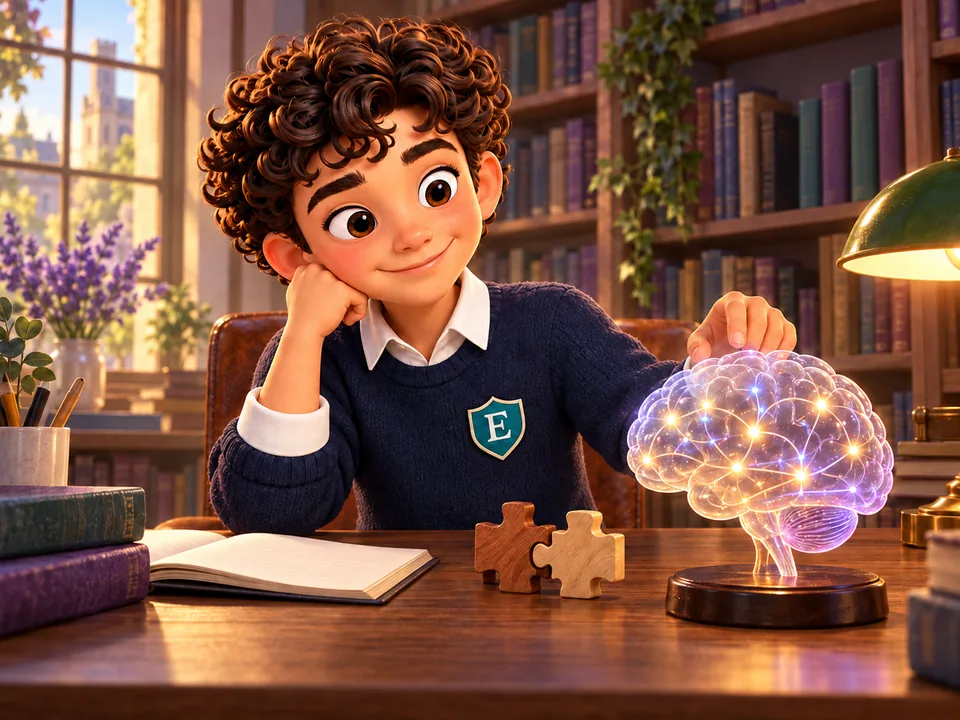
A student asks for the working definition of developmental psychology used by the APA Dictionary of Psychology. Which answer is correct?
Choose an answer, then check it.
Psychology · Foundations
developmental psychology The branch of psychology that studies the changes, physical, mental, and behavioral, that occur from conception to old age, and the factors that affect development throughout the lifespan. Full entry → is the branch of psychology that studies how people change from conception to old age. Change runs on three tracks at once: physical (the body and brain), cognitive (thinking and learning), and social-emotional (feelings and relationships). Two big questions organize the field: whether genes or environment matter more, and whether change is gradual or comes in stages. A few periods in life matter more than others, but development never stops. It is the lifelong story of becoming.
Development is the most personal subject in psychology: it is the study of how you got here and where you are going. It matters academically because later topics, from learning and memory to personality and social behavior, all build on how people change. It matters practically because any work with people, from teaching to nursing to parenting, runs on a sense of what is typical at a given age, and on knowing that growth does not end at eighteen. And it matters honestly: development is lifelong, and no single factor decides it, so the story of a person is never finished being written.
The working definition comes from the APA Dictionary of Psychology: developmental psychology is the branch of psychology that studies the changes, physical, mental, and behavioral, that occur from conception to old age, and investigates the biological, genetic, psychological, social, cultural, and environmental factors that affect development throughout the lifespan The full span of a human life from conception to old age, the scope that developmental psychologists study. Full entry →. OpenStax Psychology 2e agrees: developmental psychologists study how humans change and grow from conception through childhood, adolescence, adulthood, and death, viewing development as a lifelong process. One detail is worth pausing on: the field began in the late 1800s focused on infants, children, and adolescents, and only later, starting in the 1920s, broadened to include adult development and aging. Even the discipline's own history had to learn that development does not stop at childhood.
Developmental psychologists study change on three tracks at once. physical development Growth and changes in the body and brain, including the senses, motor skills, and health and wellness. Full entry → involves growth and changes in the body and brain, the senses, motor skills, and health and wellness. Original example: a baby's hand learns to close around a spoon, a teenager's legs grow inches in a single year, and an older adult's daily stretching keeps balance steady. cognitive development The growth and maturation of thinking processes, including perceiving, remembering, concept formation, problem solving, and reasoning. Full entry → involves the growth and maturation of thinking processes, including perceiving, remembering, concept formation, problem solving, imagining, and reasoning. Original example: a preschooler counts on her fingers, a college student follows a five-step argument, and a forty-year-old learns to play chess for the first time. social-emotional development Changes in emotions, personality, and social relationships across the lifespan; OpenStax Psychology 2e calls this domain psychosocial development. Full entry →, which OpenStax calls psychosocial development, involves emotions, personality, and social relationships. Original example: a toddler plays her first shared game in the sandbox, an adolescent's friendships become her sounding board, and two adults build a partnership over decades.
Two questions have organized the field for over a century. The first is nature versus nurture The long-running question of how much of development comes from heredity and biology (nature) versus environment and culture (nurture); researchers now treat the two as closely interacting. Full entry →. The APA Dictionary defines it as the dispute over the relative contributions of hereditary and constitutional factors (nature) and environmental factors (nurture). Nativists emphasize heredity; environmentalists emphasize family, culture, and economics. The APA entry adds the modern resolution: most scientists now accept a close interaction between hereditary and environmental factors, and OpenStax agrees, describing a reciprocal interaction. Original example: two siblings at the same kitchen table, one bold from birth, one cautious, show both sides at work: genes set the starting temperament, and shared experience shapes how each one practices it. The second question is continuity versus stages. The APA Dictionary defines it as the scientific debate over whether developmental change is gradual (continuous) or relatively abrupt (discontinuous). OpenStax spells out the two pictures: continuous development is a cumulative process that gradually improves existing skills, like a child adding inches of height year by year; discontinuous development takes place in unique stages at specific times or ages, with change arriving more suddenly, like an infant's first grasp of a hidden object's existence. Original example: a child's height creeps up smoothly, but her first word appears overnight, and her leap from counting on fingers to mental arithmetic feels like a switch flipped.
Three names anchor the field; each earns one line here. Jean Piaget proposed that children's thinking develops through a fixed sequence of stages, because children do not think and reason like adults; his theory of cognitive development is a stage theory of how the mind grows. Erik Erikson proposed that social development runs across the whole lifespan in eight stages, each built around a task such as trust versus mistrust in infancy, so personality keeps developing into late adulthood. Lev Vygotsky proposed a sociocultural theory: human development is rooted in one's culture, and a child's social world forms the basis for the formation of language and thought. Piaget looked inside the child's mind, Erikson at social tasks across a lifetime, Vygotsky at the culture around the child; enough to hold them apart without going deeper.
Some stretches of development matter more than others. The APA Dictionary defines a sensitive period A stage in development when a particular skill or characteristic can be acquired most rapidly; learning outside the period is harder but not impossible. Full entry → as a stage in development when an organism can most rapidly acquire a particular skill or characteristic. The key word is rapidly. A sensitive period is not a lock: the APA entry notes that lacking growth-dependent experiences during a sensitive period does not permanently and irreversibly affect development, as it would during a critical period, but rather makes the acquisition process outside the period more difficult. Original example: a child who hears her grandmother's tonal language daily absorbs its pitch patterns almost effortlessly, while a college student meeting the same sounds must drill them one by one; the window made the first path easy, and the second merely harder, not closed. Sensitive periods explain why timing matters in development, without turning timing into a deadline.
The most common misunderstanding is that development is childhood. It is not. OpenStax states plainly that developmental psychologists view development as a lifelong process, and the APA Dictionary notes the field broadened to account for adult development and aging. Erikson's stages run from infancy to late adulthood, each with its own task. Development is not a checklist you pass in the first two decades; it is the ongoing story of becoming, written from conception to old age. A forty-five-year-old who takes up distance running, a sixty-year-old who learns to video-call her grandchildren, a seventy-year-old who joins a book club and discovers a taste for history: these are developmental changes in the full sense of the term. The person you are at twenty is not the person you are at fifty, and that is not a failure of development. It is development.

Eli explains
Explain it like I’m 10
Development is the study of how people change, not just in childhood but from the start of life to its end. The change runs on three tracks at once: your body, your thinking, and your feelings and relationships. Psychologists argue about two big things: whether genes or experiences matter more, and whether change creeps along smoothly or arrives in leaps. Piaget, Erikson, and Vygotsky each gave a different lens, stages of thinking, stages of social tasks, and culture as the engine. Some periods of life matter more than others, but no window slams shut: development is the lifelong story of becoming.
Think of a city that never stops building. New streets appear, which is physical growth; the transit map gets redrawn, which is cognitive growth; and neighborhoods form new ties, which is social-emotional growth, all at once, from founding to old age. Some decades are building booms when one skill comes together quickly, but construction never ends.
A city's growth is planned by officials working from budgets, while development has no single planner, genes and experience interact without a blueprint. A city can demolish old buildings and start over, but a person carries early experience forward instead of discarding it. And a building boom follows money and policy, while a sensitive period follows biology and timing.
Maya played violin as a child and stopped at sixteen. At sixty-two, retired, she joins a community orchestra's cello section. The first months are hard: her fingers ache during practice (physical development), reading bass clef feels like learning a new language (cognitive development), and she nearly quits before the cellist beside her shows her a fingering trick, and the friendship keeps her showing up (social-emotional development). A year later she plays her first concert. None of this contradicts her age; it confirms the lesson. Some skills came faster when she was young, a sensitive period at work, but nothing closed. The story of becoming kept going, and at sixty-three it added a cello.
Development is the lifelong story of becoming: physical, cognitive, and social-emotional change from conception to old age, shaped by the interaction of nature and nurture, sometimes gradual and sometimes in stages, with some periods mattering more than others, but never finished early.
3 questions here, of 5 in this lesson’s practice set. Answers stay hidden until you check.
"Development means childhood; after that, people just age."
Developmental psychologists study the whole lifespan, from conception to old age. OpenStax describes development as a lifelong process, and Erikson's stages run into late adulthood, so growth continues long after childhood.
"Nature and nurture are rival answers, so you have to pick one."
The APA Dictionary notes that most scientists now accept a close interaction between hereditary and environmental factors, and OpenStax describes the two as reciprocal. The interesting questions are about how they interact, not which one wins.
"A sensitive period is a deadline: miss it and the skill is lost forever."
A sensitive period is when a skill is acquired most rapidly. The APA Dictionary is explicit that missing it makes acquisition more difficult, not impossible, which is what separates a sensitive period from the stricter critical period.
"Real development always comes in stages; gradual change does not count."
Continuity and discontinuity are both descriptions of observed change, and theorists debate which dominates. Gradual cumulative change, like a child's height, is development too, and it is the picture continuous theories describe.
Nature is heredity and biology; nurture is environment and culture. The APA Dictionary defines the question as their relative contributions, and modern psychology treats them as closely interacting rather than competing.
Continuous change is gradual and cumulative, like height adding inches year by year; discontinuous change arrives in stages, like the sudden appearance of a first word. The two are competing descriptions of how change happens.
A sensitive period is when a skill is acquired most rapidly, and learning later is harder but possible. A critical period is an early window of openness that will not recur, so a missed experience is far more consequential. The APA Dictionary treats them as distinct.
EliExplains lessons are original prose written from the open, credible references above. See Copyright & Licensing.
Researched 2026-08-22
Educational content only. It is not medical, legal or professional advice. Found an error? Tell us.
