
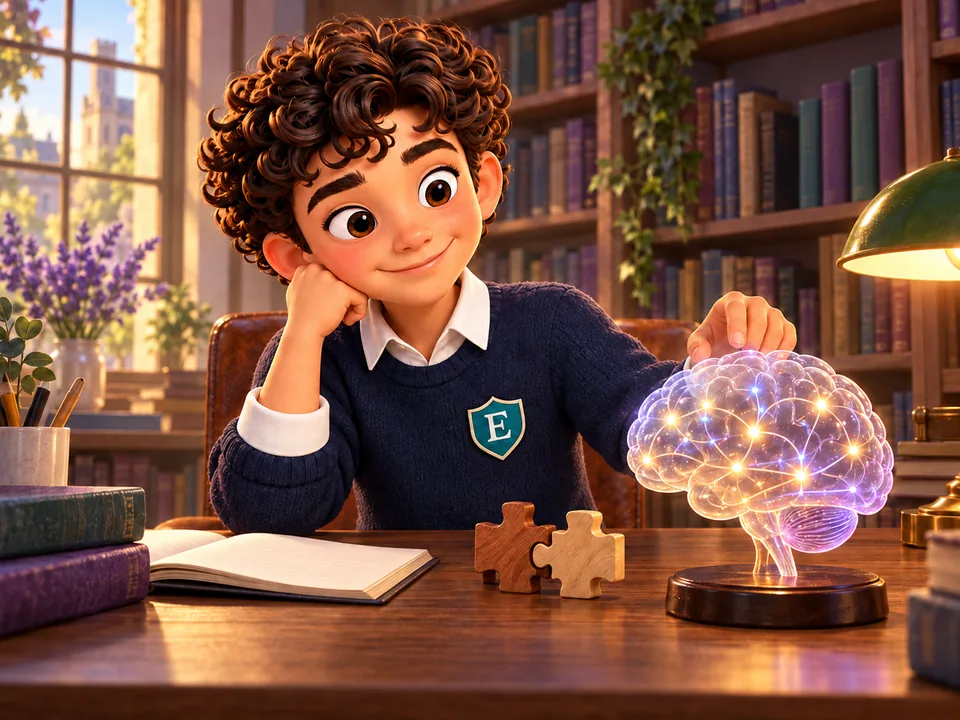
A psychology student is asked for a working definition of encoding. Which answer matches how the APA Dictionary of Psychology and OpenStax Psychology 2e describe it?
Choose an answer, then check it.
Psychology · Foundations
encoding The process of turning experience into a form the memory system can process and hold — the first stage of memory. Full entry → is the process of turning experience into a memory trace — the first stage of memory, before storage and retrieval. Psychologists describe three main routes: acoustic encoding Sound-based encoding, as when the melody of a song is what you remember. Full entry →, which works by sound; visual encoding Image-based encoding, as when you remember a parking spot by picturing it. Full entry →, which works by image; and semantic encoding Meaning-based encoding, as when you remember a term because you understand what it does. Full entry →, which works by meaning. Meaning is the deepest route: information you think about lasts longer than information you merely repeat. attention The process of focusing on selected information while ignoring the rest; encoding depends on it. Full entry → opens the door, and strategies like chunking Organizing material into meaningful groups to make it easier to hold and remember. Full entry →, mnemonics, and rehearsal help — but none of them guarantees a memory. Encoding is the door into memory.
Encoding is the door into memory: if experience never gets encoded, there is nothing to store and nothing to retrieve. Understanding encoding explains everyday puzzles — why you can repeat a name all evening and still forget it by morning, why a face you glanced at for two seconds is gone, why thinking about what a word means beats mouthing it. It matters academically because acoustic, visual, and semantic encoding and the depth-of-processing account are core vocabulary in psychology courses and research. It matters practically because choosing how you take information in is the cheapest memory improvement you can make. And it matters honestly: encoding aids raise your odds, and knowing they are not guarantees keeps your expectations — and your studying — honest.
Encoding is the process of turning experience into a memory trace — the first stage of the memory sequence. The APA Dictionary of Psychology defines encoding as the conversion of a sensory input into a form capable of being processed and deposited in memory, and places it first, followed by retention and then retrieval. OpenStax Psychology 2e describes encoding as the input of information into the memory system — the way information gets into memory in the first place. The Noba Project's memory module makes the same observation in plainer language: encoding is how you transform a physical, sensory input into a representation that can be stored. Three authoritative sources, one working definition: before anything can be remembered, experience must be converted into a form the memory system can hold. That conversion is encoding. This lesson treats it as the door into memory: nothing gets stored or retrieved that did not first come through it.
Psychologists distinguish three main types of encoding by the kind of information they use. Acoustic encoding works by sound. Original example: you learn a song's chorus by hearing it — the melody and the rhyme of the words are what stick. Visual encoding works by image. Original example: you remember where you parked by picturing the row of cars and the blue sign at the end of the lot. Semantic encoding works by meaning. Original example: you remember what a mitochondrion is because you understand it as the cell's energy producer, not because of how the word sounds or looks. The APA Dictionary of Psychology has a separate entry for each type, and OpenStax Psychology 2e describes all three as routes into memory. The types are not mutually exclusive — a single experience is usually encoded through more than one route — but which route dominates shapes how well the memory survives.
Why does semantic encoding seem to leave stronger memories than acoustic or visual encoding? The best-known answer is the depth-of-processing account, proposed by Fergus Craik and Robert Lockhart in 1972. They argued that memory depends on how deeply information is processed when it is encountered: shallow processing works on surface features like sound or appearance, while deep processing works on meaning, and deeper processing produces more durable traces. OpenStax Psychology 2e describes the account in just these terms: information that is thought about more deeply is more likely to be remembered, which is why elaborative rehearsal Linking new information to existing knowledge to support longer-lasting encoding. Full entry → — connecting new material to what you already know — outperforms simple repetition. Original example: two students learn the same biology term. One repeats the word aloud ten times, encoding by sound. The other asks what the term does and how it fits with what she already knows, encoding by meaning. A week later the second student remembers; the first draws a blank. Meaning beats repetition — not because repetition is useless, but because meaning engages more of the memory system.
Encoding does not happen automatically for everything you encounter; it needs attention. The APA Dictionary of Psychology defines attention as the process of focusing on selected aspects of the environment while ignoring others, and OpenStax Psychology 2e is blunt: if you do not attend to information, you will not encode it well enough to remember it later. Original example: you walk through a crowded station with your mind on a problem, and five minutes later you cannot say what the announcement over the loudspeaker said. The sound reached your ears — that is not the failure. Attention never opened the door, so encoding never happened. Attention is the bouncer at the door of memory: it decides which experiences get in.
Because encoding is something you do, not something that happens to you, psychologists have studied strategies that make it work better. Chunking organizes material into meaningful groups. Original example: instead of twelve separate digits, you group 149217761939 into 1492, 1776, and 1939 — three dates you already know. The APA Dictionary defines chunking as organizing material into meaningful groupings, and OpenStax Psychology 2e's section on ways to enhance memory presents it as a way to get more into short-term memory. Mnemonics are memory aids that give information a structure or a hook. Original example: “Every Good Boy Does Fine” hangs the notes of the treble staff on a sentence. Rehearsal comes in two forms: maintenance rehearsal Simple repetition that keeps information in short-term memory. Full entry →, simple repetition that holds information in short-term memory, and elaborative rehearsal, linking new material to existing knowledge, which supports longer-lasting encoding. Both are defined by the APA Dictionary and recommended by OpenStax. And here is the honest note: these strategies help, but they do not guarantee memory. A mnemonic A memory aid that gives information a structure or hook, such as a sentence built from first letters. Full entry → that organizes a list does not make the list unforgettable; an elaborative connection can still fade. Encoding strategies raise your odds — they do not seal the deal.

Eli explains
Explain it like I’m 10
Encoding is how experience gets into memory. When you see, hear, or think about something, your brain turns it into a form it can work with — that conversion is encoding, and it happens before storage and retrieval. There are three main routes: by sound, by image, and by meaning. Meaning is the strongest route, which is why thinking about what something means beats repeating it over and over. Encoding also needs attention: if you are not paying attention, the experience never gets in. You can get better at encoding with strategies like chunking, mnemonics, and rehearsal, but those strategies improve your odds — they never guarantee that a memory will last.
Think of encoding as the front door of a house. Attention is the doorknob: nothing opens the door unless you turn it. Each guest who walks in arrives one of three ways — carried by sound, carried by picture, or carried by meaning. The guests who arrive by meaning are the ones who stay longest, because they came with luggage: meaning connects the new guest to the furniture already inside.
The front door is a fair image for attention and for the three routes, but it flatters encoding: a guest who walks through a door is inside to stay. A memory trace is not a guest — it is a change in the brain that can fade, and even a meaning-encoded memory can be forgotten. Strategies like mnemonics are more like handing a guest a map than locking the door behind them.
Mateo has to remember the chemical symbols and atomic numbers of the first ten elements for Friday's quiz. On Monday he reads the list aloud five times, letting the sounds wash over him — maintenance rehearsal, acoustic encoding. By Tuesday he has forgotten the numbers for beryllium and boron. He changes tactics. He groups the list into meaningful pairs — hydrogen and helium, the two lightest gases; lithium and beryllium, the metals that begin the second row — chunking the material into units he can picture on the periodic table. For each element he asks a meaning question: why is carbon number six, and what does oxygen's number eight let it do? That is elaborative rehearsal, semantic encoding. By Thursday the symbols come to him as a picture of the table, and the numbers as reasons. Friday's quiz goes well. What changed was not his effort but his encoding: sound gave him nothing to hold, while meaning and structure gave his memory something to grab.
Encoding is the door into memory: experience must be converted into a memory trace, and how you convert it — by sound, by image, or by meaning — shapes how well it lasts. Attention opens the door, meaning deepens the trace, and strategies like chunking, mnemonics, and rehearsal help — but none of them guarantees a memory.
3 questions here, of 5 in this lesson’s practice set. Answers stay hidden until you check.
“Encoding is the same as attention — paying attention is the whole job.”
Attention is the door, not the room. Attention lets information in, but encoding is the conversion of that experience into a memory trace; you can attend to something and still encode it poorly, as when you watch a lecture while checking your phone.
“Repeating something over and over is the best way to encode it.”
Repetition is maintenance rehearsal — it holds information briefly. The depth-of-processing account (Craik and Lockhart, 1972) predicts that meaning-based, elaborative encoding produces more durable memories, which is why thinking about what a term means beats mouthing it.
“All encoding is either visual or acoustic — there are only two routes.”
There is a third route: semantic encoding, by meaning. The same word can be encoded by its sound, its look, or its meaning — and the meaning route is the deepest.
“I encoded it, so I should remember it — encoding guarantees the memory.”
Encoding is only the first stage. A trace can still fade during storage, and retrieval can fail even when the trace is there. Strategies raise your odds; nothing guarantees a memory.
“A mnemonic is a foolproof memory trick.”
Mnemonics organize information and give it a hook, which helps — but the hook is not the memory. A mnemonic you cannot reconstruct is useless, and even well-organized material can be forgotten.
Encoding is the process of getting experience into the memory system; storage is holding the encoded information over time. Encoding is the doorway, storage the room beyond it.
Acoustic encoding works on sound — how a word rings; semantic encoding works on meaning — what a word does. The depth-of-processing account predicts the meaning route leaves the more durable trace.
Maintenance rehearsal is repetition that keeps information in short-term memory; elaborative rehearsal connects new material to existing knowledge and supports longer-lasting encoding. One holds the line, the other builds the road.
EliExplains lessons are original prose written from the open, credible references above. See Copyright & Licensing.
Researched 2026-08-22
Educational content only. It is not medical, legal or professional advice. Found an error? Tell us.
